Wednesday, 12 November 2014

Hluhluwe to Maguga Lodge in the Kingdom of Swaziland.

An 8am start in drizzling rain this morning for the 1.5 hour drive to the Swaziland border. The protea Hotel was a good base for what we covered and overall it was a pleasant stay. The highlight for many of our shopaholics was the hotel gift store that had some of the most competitive prices and quality items encountered to date.

Leaving South Africa was relatively simple but the checkpoint between the 2 countries was elaborate and formal and we had to walk into Swaziland to complete their immigration. This is rather ironic since you can go 100 metres either side and simply walk anywhere. This is one of the reasons South Africa is facing a refugee crisis with relatively open borders. The Kingdom of Swaziland is administered by King Swazi the third, an absolute monarch who doesn't take dissent from his subjects. He has 14 wives, several palaces and is reportedly worth US$2 billion. 45% of his 1.2 million subjects live in abject poverty and this is quite evident, especially between the border and the capital Manzini.

The scenery in Swaziland is worth a special mention. As you enter the country you are immediately aware of a relatively flat broad valley with what appears to be an escarpment on your right. At the base of this is the very long Pongolapoort Dam. The escarpment has all the features of a fault and some scientists believe it is an extension of the Great African Rift Valley. The poorest subsistence farmers tend goats and cattle and many can be seen on the verges of this busy highway. As the soil improves, much larger sugar estates can be seen and several towns had processing mills and one a distillery. The mountains tend to close in as you approach Manzini and the terrain is much hillier. What really surprised was the number of quality homes around the capital and one can surmise that these belong to people in the government.

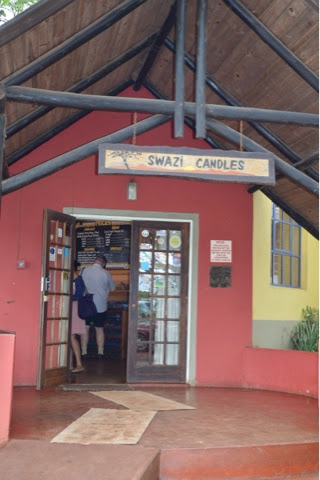
We drove through the capital to the Swazi Candle factory for lunch and a demonstration of candle making. The young man moulding produced a rhinoceros shaped candle in 5 minutes and his artistry was a sight to behold. The site also had many market stalls to encourage our shoppers. We arrived in Maguga Lodge around 4pm after traveling through some beautiful mountain scenery. Basalt was the base rock for some of this drive and the associated red soils were rich and supported more extensive farming.

Our accommodation at Maguga was in Rondavel huts with thatched roofs and the site overlooked the impressive Maguga Dam. Impala were wandering around the huts this afternoon and it was interesting to see signs that said beware of hippos and crocodiles down near the dam.

Some of the following photos were taken from the bus, hence the poor quality.


Tuesday, 11 November 2014

Hluhluwe to St Lucia and return

We had a close encounter with a charismatic Zulu this morning at the Dumazulu Cultural Centre. Madangalazana met us at the entrance after stepping out of his Mitsubishi ute and spent the next 30 minutes entertaining us in Zulu but still managing to make some cultural points, especially relating to marriage. When we were totally bamboozled he managed to drop a few words in English to steer us through. Our guide Tholi, took us through the rest of the Kraal and she explained various aspects of culture, culminating in a traditional dance.

An hour later we were in St Lucia. (Pronunciation is like lucifer without the "f") This is a large wetland area and is arguably the oldest park in the world, a title disputed by Yellowstone in the US. It has a variety of large animals but the feature animal is the hippopotamus. It also lays claim to having the greatest biodiversity in South Africa with over 400 indigenous tree species and 526 bird species. As you cruise the wetland, 3 main species stand out on the river bank. These are the swamp hibiscus, white mangrove and wetland reeds, the latter being well utilized by the yellow weaver birds. It was interesting to note that the hibiscus were in flower and this coincided with the bird nest construction as the yellow weaver bird sought refuge from predatory eagles amongst the yellow hibiscus flowers

Our first large animal encounter was with a Nile Crocodile, the only species in Africa. The hippos stole the show however and conservatively we must have seen over 70. The largest pod had over 30 members with males and females and babies. One or two were quite cantankerous and put on a brief show of aggression for the tourists but generally they were enjoying their soporific slumber. A number of males were active in the water as they made periodic surfacing for air. It is interesting that hippos can't swim or float and they simply walk across the bottom and push themselves off the bottom to breathe as their heads emerge. It was sobering to see warning signs in the town making people aware of hippos wandering the streets at night and this was supported by photos, one seen drinking from a backyard pool. Perhaps they did get one for Christmas!!

A variety of bird life was observed, the largest being the Goliath Heron which was over a metre tall and had a wingspan of 1.3 metres. The largest fish ever pulled out of the wetland was a 240kg potato bass which is now in an aquarium in Durban. The other animals in the photos below are Water Bucks.

We hit the local fish shop for a late lunch which was served by 2.45pm. Fish and chips were on special and were a bargain at $2.90 per person. This included copious chips, tartare sauce and 2 large pieces of tasty fish. All food is ridiculously cheap compared to Australia and this also includes drinks. A great day's spotting to end the Hluhluwe experience. Tomorrow we leave Kwazulu-Natal Province and enter the Kingdom of Swaziland.


Monday, 10 November 2014

Hluhluwe Safari

We met our guide outside the hotel right on schedule at 7am and headed out for the 20 minute drive to the park. The vehicle was an old Land Rover with raised seats, open sides and a canvas tarp roof and after 20 minutes with an open front we were fairly wind blown. The Hluhluwe park was established in 1895 and is 95,000 hectares in area. The whole park is bordered by electric fencing to keep the animals in and the poachers out. After you enter the compound  you are free to drive around the maze of roads with the proviso that you stay in your vehicle unless at a designated toilet stop or viewing point. Speaking of toilets, the first photo shows a scorpion that was crawling around in the ladies. Our Zulul guide Tayla, was a source of information and a brilliant spotter of animals. We did improve with the spotting after we acclimatized to the environment but at times you could be 10 metres from an animal and not see it with their amazing camouflage.

This park has a large number of rhinos in what is a fast disappearing species. The reason for this is that rhino horn fetches US$65,000 per kilogram on the black market and there are entrepreneurs holding onto stocks in the hope that rhinos become extinct and the price soars. The main use for the horn is in Chinese medicine, not the often reported aphrodisiac.

We saw many different species today and I'll let the pictures tell part of the story. I do need to highlight a few encounters however. We came across a herd (parade) of about 20 elephants heading for the river and they crossed the road directly in front of us. Some came towards us from the side and as they approached the Land Rover you felt the vulnerability of being so close in an open vehicle. In another spot, we rounded a corner to come face-to-face with a herd of zebra, up close and personal. The up close rhino encounter came as we were leaving the park. Lions and giraffes were also spotted but at some distance. One of the most remarkable animals is the dung beetle and we spotted a pair on the road late in the day. The female had laid an egg inside the ball of dung (which was about 100mm in diameter) and the male was rolling it onto the grass verge and then over a small dead branch with the female as a passenger. The ball is then buried to hatch the egg. No wonder they have right of way on the roads.

The landform in the park is best described as undulating to hilly. The vegetation is more bushy than the savanna that you often relate to Africa and much of it is a type of thorn bush with spikes around 50mm in length. Most of the trees were dispersed and not overly large in height.

Today was a special one and by all accounts from our guide, an excellent one for spotting.

Sunday, 9 November 2014

Sani Pass hotel to Hluhluwe

We woke to another beautiful cloudless day at the Sani Pass Hotel but with a long day ahead of us we were on the move by 8am. The journey to Durban was through lush dairying country with large farms the norm. The scenery through the South Drakensberg Mountsins was spectacular with tall grassy slopes giving way to quite deep broad valleys. After about 50 kms he extensive farms gave way to more intensive settlement and the poorer houses appeared. This appeared to be when the fertile red earths of basalt origin gave way to poorer soils. The round huts or Rondavel are very common throughout this province of Kwazulu-Natal. What has really impressed is the huge area planted out to pine and eucalyptus species. The eucalypts are often planted around 3 metres apart in both directions and are stripped of their lower branches, leaving a small crown of leaves. They grow straight and when about 180-200 mms in diameter they are harvested for timber. Many are also grown for wood pulp.

Durban is different to all the other cities that we have encountered and more similar to Australian cities in that there is a variety of architectural styles from old to new and considerable gentrification around the port area. It had a multicultural flavour with many religions being represented by large places of worship. We had lunch at a mall loosely styled along Zulu culture called uShaka.

We headed north along the coastal route and rejoined the N2 for our last 200 kms to Hluhluwe. At this point I should explain this is pronounced "shloo shloo we". The planted forests occupied much of this leg but it was interspersed with sugar cane, much of which is currently being fired and harvested. We did stop at a market close to our destination and the smell of fresh pineapples was really intoxicating. The photos will show it all.

The Protea Hotel here in Hluhluwe is an adequate base for the coming safari activities. There was a Zulu dance exhibition tonight with some frenetic gyrations of bodies and then an invitation to join in. Tour leader Dorothy took to the floor in style but the high kicks were a challenge. 

Saturday, 8 November 2014

Sani Pass

We knew this was going to be something special when the mist cleared around 9am to reveal the most beautiful panorama from the Sani Pass Hotel. It developed into a picture postcard perfect day with just a few splashes of cumulus cloud to make the sky a pastel blue and white contrast. Our 4x4 drivers arrived on schedule and we were underway by 9.30am and ready to climb the pass. The first section of 13kms to the South African border was rough but not particularly steep and as we wound our way into the mountains the lush green of the valley opened up before us and the higher we got, the more spectacular it was. Our guide was a Zulu lad by the name of Basumi and he told us a little about himself and his people including the initiation of teenage boys by cutting the face. In fact he was about to do that to his 15 year old in the coming weeks. He was also a mine of information about the Lesotho people.

Border procedures took about 15 minutes and we were on our way again for 8kms in no man's land until we reached the Lesotho border at the top. The hills with the southern aspect were a vivid green as the photos show and this was because Rangers had burnt off the old grass to regenerate new growth. Quite a few species of flora and fauna inhabit the mountain but the only animal we saw was a family of baboons. On the lower gradients of the road there was an orange/red tinge to the slopes with numerous stands of the native Watsonia and I have included them in the photos.

The Lesotho border was at the summit after we negotiated a series of hairpin bends with a steep gradient. The view at the top was breathtaking and you just felt you wanted to stay there and admire it in the sunshine, albeit a little cooler at 2874 metres a.s.l. Passport procedures here were quick and easy and we drove straight to the highest pub in Africa to order our lunch before continuing on to a village about 5 kms down the road. To say the Lesotho people do it tough is an understatement. Their houses were round and constructed of stone with a conical thatched roof. Floors were clay and they burned cow dung to cook and heat the building. Their primary source of income was from wool and young boys acted as shepherds as flocks roamed the hills. This was the most basic subsistence farming. They also kept some cattle for milk and meat. We were invited into one of their houses and the 23 year old girl who owned it served us bread cooked from the heat of the cow dung fire.it was delicious but we declined the offer of home brewed beer offered to everyone from the same cup. Weaving is another pastime for both practical needs and the tourist trade. Many of the people go to work in South Africa because of the poverty. This brings another problem in that many return with the HIV virus and in fact the girl we met had lost both parents from it.

It should be noted that the Lesotho section of the Pass is being developed for free by the Chinese. They have built bridges and will asphalt the road and the only trade-off is that they are allowed to develop and run a diamond mine. There are certainly some ethical questions here.

The journey down the Pass was just as spectacular and new colours and contrasts emerged because the sun was in a different postion in the afternoon. This was certainly up there with the best of mountain experiences and a stunning introduction to the South Drakensberg Mountains.